Best Facial in Istanbul: What to Check Before Booking
Best Facial in Istanbul: What to Check Before Booking
Best facial in Istanbul is a search with a clear practical intention: compare providers and book a service that fits your skin. But “best” is not an independently awarded status. This guide offers a verifiable decision checklist for reviewing clinics, photographs, branded equipment, hygiene, consultation quality and realistic expectations—without ranking a provider on unsupported claims.
Use the questions below to decide whether to book a conservative facial, request more information, or seek a qualified medical assessment instead. The most helpful answer is often a precise explanation rather than a larger treatment package.
Before booking a facial in Istanbul: ask what the appointment includes, whether the proposed steps suit your skin, how hygiene is handled and what aftercare you may need. Those practical answers matter more than a promotional label or a generic ranking.
What does “best facial in Istanbul” actually mean?
People searching for the best facial in Istanbul are usually comparing more than a treatment name. They want a reliable place, clear communication, appropriate hygiene, a sensible treatment recommendation and a result that fits their schedule. “Best” is a personal decision shaped by skin condition, comfort, risk tolerance, budget and travel plans. It is not a clinical accreditation or an objective title awarded by search engines.
A provider may offer sophisticated products and equipment yet be the wrong choice for someone with active irritation or only one free afternoon. Another provider may be excellent at conservative facial care but unsuitable for a medically complex complaint. This guide treats “best” as a set of verifiable standards: what you can check before booking, what should happen in consultation and how to recognise when a facial is not the right next step.
Start with one clear skin goal
Try to describe your goal without naming a device. “My skin feels tight after cleansing,” “I want a comfortable maintenance facial before my trip,” or “I have visible congestion on my nose” provides more useful information than “I want the strongest facial.” Separate temporary appearance goals from long-standing skin problems. Flaking, acne, pigment changes and redness can have different causes even when they appear in the same photograph.
Write down recent products and reactions. An unfamiliar peel, newly introduced retinoid, sunburn or severe dryness may change what should be done. If an issue is painful, persistently inflamed, infected or suspicious, the best next step could be medical assessment rather than a routine beauty appointment.
How to interpret Google search and map results
Google rankings, advertisements and local map listings help you discover options; they do not independently certify treatment quality. A sponsored result is a paid placement. A high number of reviews can reflect visibility, age or the volume of appointments, not necessarily better suitability for your own skin. Focus on whether the listing explains the location, service options and booking process, and whether information agrees with the official website.
Look for consistent business details and a sensible description of the services offered. Be cautious if one page claims every treatment cures acne, erases scars and produces permanent changes without qualification. Check whether a named branded system is actually identified and whether testimonials make promises that could not be reliably generalized. Photographs may be real, stock or illustrative; ask what they show before relying on them.
Read reviews for specific signals, not just star ratings
A helpful review may describe whether the consultation was clear, the appointment started on time, the service matched what was explained and the team answered aftercare questions. Reviews mentioning communication with international visitors can be informative about language support. However, an individual’s before-and-after story is not controlled clinical evidence, and a good experience does not prove that a product or device is appropriate for everybody.
Read a mixture of recent positive, neutral and critical reviews. Notice whether the business responds constructively rather than making unverifiable claims. A small number of highly emotional comments should not replace assessment of the actual service. If a review describes a medically significant complication, seek better information about how follow-up and referral are handled rather than assuming the same outcome will happen to you.
Verify equipment and product identity
A clinic using the name Hydrafacial should be able to identify the genuine branded system. Hydrafacial’s manufacturer describes its own multi-step platform; not every machine that uses suction and liquid is the same device. If a website shows equipment, the image should depict the actual brand and model rather than a fabricated or vaguely similar instrument. For peel products, a provider should be able to explain the brand, the selected formula and the reason it might be appropriate. At Nexja, HydraFacial takes 45 minutes.
Professional skincare labels such as mesoestetic, Dr. med. Christine Schrammek and Rejuvi refer to distinct manufacturers and product lines. Their appearance in a photograph does not prove that they are included in a given booking. Ask about exact products when relevant, but do not assume that one manufacturer’s serum is approved for use inside another brand’s machine. Accurate brand presentation and an honest explanation matter more than a crowded product display.

Expect an individual assessment
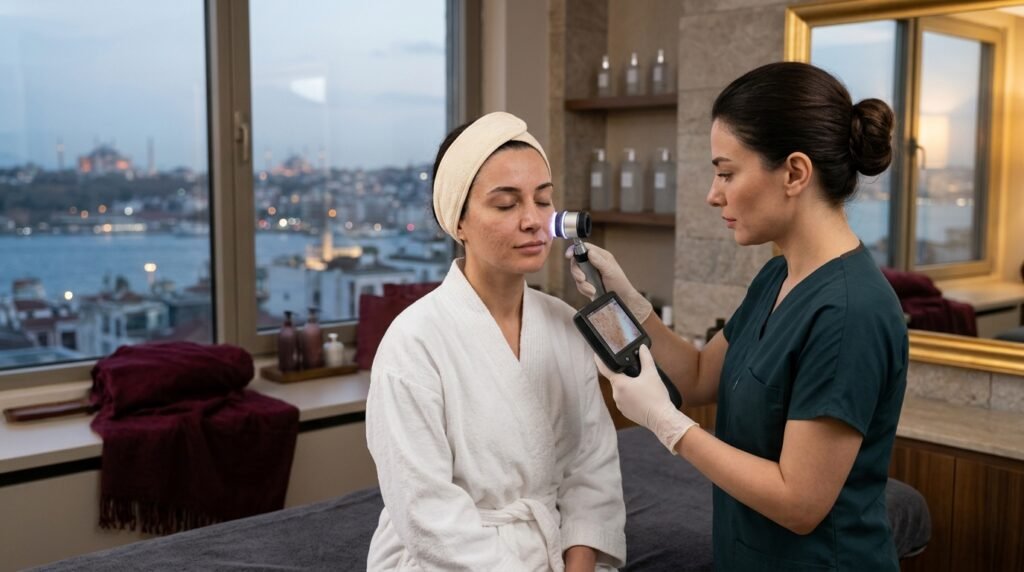
A thoughtful provider begins by discussing the skin, not by insisting on the most expensive package. The conversation should cover your concern, relevant medical and product history, existing irritation, past treatments and near-term plans. Visual inspection and optional photos can be useful, but neither an AI label nor a skin scanner score can diagnose every skin condition or dictate treatment alone.
A useful answer connects observation to action: why a certain level of cleansing or exfoliation is proposed, what alternatives exist and what would make the team postpone treatment. A professional should be willing to explain when a more conservative option is appropriate. If a changing pigmented lesion, unexplained rash or active infection is present, a qualified clinician should assess it rather than allowing a cosmetic consultation to substitute for diagnosis.
Check hygiene and handling, not just décor
A beautiful room is pleasant, but hygiene is a separate question. Observe whether hands, reusable surfaces, tools and work areas are managed appropriately for the procedure. Different methods involve different equipment and hygiene requirements. The provider should explain how extraction tools or applicators are handled and which items are single-use where applicable.
A product with an appealing bottle is not automatically safe for irritated skin. Contact time, ingredients and use instructions still matter. Ask how the staff respond if you develop burning or discomfort during a mask or exfoliating step. The American Academy of Dermatology advises stopping a mask if itching, burning or stinging occurs. An appropriate response to symptoms is more meaningful than a promise that discomfort is always normal.
Compare facial categories without treating them as identical
A gentle maintenance facial may emphasise cleansing and moisturising comfort. A congestion-focused service may include assessment and careful extraction where indicated. Device-assisted options may involve a branded hydradermabrasion-style process. Professional peels require their own suitability and recovery considerations. Names such as “glow,” “premium” and “signature” are not internationally standardised treatment specifications.
Ask each provider for a plain-English explanation of the service instead of comparing package titles alone. If a peel is proposed, discuss the type and depth, expected redness, skin tone considerations and preparation. Some peels require substantial downtime, so a generic “lunch-break” description is not appropriate for every procedure. A simpler treatment can be a more suitable choice for an upcoming event or a person whose skin has reacted previously.
Consider your Istanbul itinerary before booking
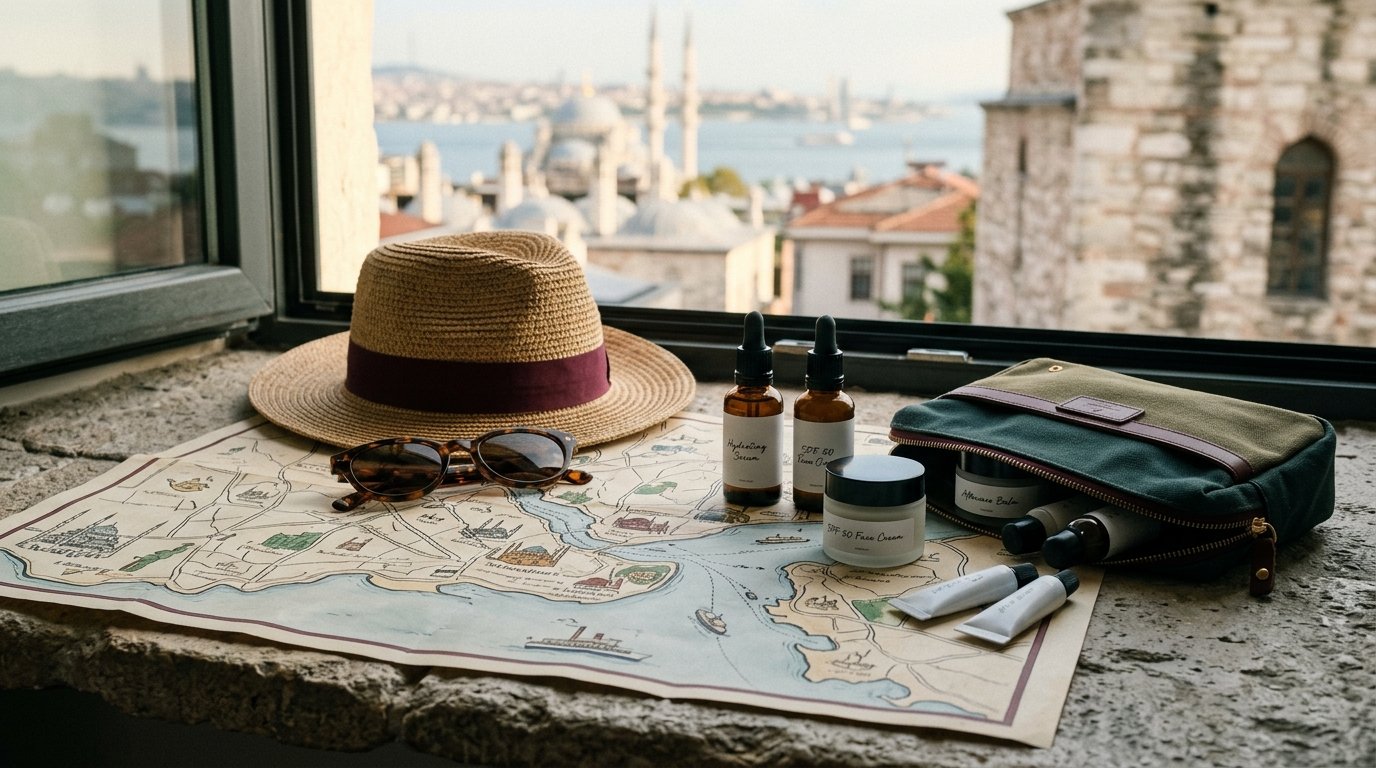
If you are visiting Istanbul, a facial is part of your travel schedule, not an isolated appointment. Long days outdoors, strong sunlight, walking, sweating, makeup, flights and limited access to follow-up can all affect the decision. A first-time, intensive peel the day before a wedding or long return journey may be a poor fit even when the treatment is suitable at another time.
Tell the provider when you will leave Türkiye and whether you expect to spend much of the next few days outside. Ask about possible visible irritation, which activities to avoid and how to reach the clinic if symptoms appear after returning home. There is no universal promise that every facial requires no recovery. Specific aftercare should match the actual steps performed.
Ten practical questions before booking
Use a focused list rather than relying on a long promotional description. Ask: What is included in this appointment? How is suitability checked? Is the named device genuine? Which kinds of products might be used? Are any steps optional? What reactions are plausible? Is downtime expected? What preparation and aftercare apply? Who handles problems or referral? Is the price for the full described service?
These questions do not need to turn a relaxing appointment into an interrogation. A competent team can usually provide concise, practical answers. If a concern is outside the provider’s scope, acknowledging the limitation is a positive signal. Requests for current pricing and inclusions should be answered from live clinic information, not from an old advertisement or fabricated figures.
Marketing red flags worth noticing
Be cautious with permanent pore-closing claims, guaranteed acne cures from one facial, universal “suitable for every skin” descriptions, invented qualifications and photographs implying that illustrative results were achieved at a particular clinic. A treatment labelled “medical” is not automatically performed by a physician, and a website’s professional-looking aesthetic does not verify credentials.
Pressure to book a costly combination without assessment is another warning. A provider should distinguish a cosmetic facial from diagnosis and treatment of skin disease, including suspected infection, persistent dermatitis, severe inflammatory acne or changing lesions. The right answer may involve delaying the procedure. A transparent explanation of limitations is a quality signal, not a weakness.
Understanding a personalised facial experience
At Nexja, the Select idea describes a deliberate choice of products, professional technologies and protocols. That philosophy should translate into a specific reason for any recommended step rather than the assumption that more treatments are better. Nexja Butterflies refers to the selected team members responsible for carrying out the experience; it is not a label applied to customers. Nexja Experience refers to the journey from first enquiry to assessment, planning, the appointment and aftercare.
For a prospective visitor, these concepts are useful only if they lead to clear communication and realistic expectations. A premium promise should not be a substitute for product transparency, appropriate medical referral or individual consent. Always confirm current service availability and the exact plan before booking.
A simple final decision framework
Shortlist providers whose services match the goal, then compare their explanations rather than their superlatives. Give weight to transparent credentials and scope, ability to discuss contraindications, treatment-specific hygiene, honest product descriptions, clear follow-up and the visitor’s schedule. Avoid purchasing several procedures solely because they appear in an attractive bundle.
If your skin is comfortable and your objective is modest, a conservative approach may be enough. If you need help with persistent inflammatory disease or suspicious changes, seek a clinician qualified to diagnose the issue. The “best facial in Istanbul” is the one that fits the person, not simply the clinic with the loudest claim.
Service comparison: what to check
| Provider claim | Useful verification | Reason |
|---|---|---|
| Best facial in town | Named process, transparent inclusions, appropriate assessment | Superlatives do not establish suitability |
| Branded Hydrafacial | Actual device identity and session components | Not all hydradermabrasion equipment is Hydrafacial |
| Deep cleansing | Extraction method, contraindications, hygiene | Inflamed skin may need a gentler approach |
| Professional peel | Peel depth, aftercare and risk discussion | Recovery varies substantially |
| Premium products | Exact formula, skin compatibility and rationale | A label does not prove an outcome |
Frequently asked questions
Is there one objectively best facial in Istanbul?
No. Suitability depends on your skin, goals, provider competence, chosen protocol and aftercare.
Are high Google ratings proof of clinical quality?
No. Ratings describe user experiences but cannot establish medical safety or suitability by themselves.
How can I check if a clinic really uses Hydrafacial?
Ask for identification of the actual branded system and the specific session components; avoid judging from a generic stock picture.
Is a deep cleansing facial always preferable?
No. Intensive extraction or exfoliation may be unsuitable for irritated, inflamed or reactive skin.
What makes a facial suitable for sensitive skin?
Careful assessment, attention to triggers and a low-irritation plan; an active skin disorder may need medical evaluation.
Do expensive products guarantee results?
No. Appropriate formulation, patient-specific tolerance and correct use matter more than price or packaging.
Can one facial permanently eliminate acne or scars?
No. Such promises are not realistic; ongoing medical conditions and scarring require individual assessment.
Should I choose a peel just before travelling?
Consider the type of peel, downtime, sun exposure and follow-up access; a more conservative option may be better.
Is a consultation really necessary?
It helps identify contraindications, allergies, realistic goals and whether a cosmetic procedure is appropriate.
What is the role of a dermatologist?
A dermatologist can diagnose medical skin conditions and assess the suitability of medical cosmetic treatments.
Can a skin scanner select the ideal facial?
No. Instrument readings are supplementary and must be interpreted with history, examination and judgement.
What if a mask burns or itches?
Tell the provider and stop the suspected product; obtain medical help for persistent or severe symptoms.
Are branded facials identical across clinics?
No. Confirm exact steps, products and optional add-ons; brand names and package names alone do not define the entire service.
How should tourists plan aftercare?
Ask about sun protection, likely reactions, activities, contact details and follow-up after leaving Istanbul.
How do I compare prices fairly?
Compare included steps, provider expertise, duration, exclusions and follow-up rather than headline prices alone.
Can I wear makeup straight after any facial?
There is no universal rule; follow the instructions appropriate to the actual procedure and skin condition.
Do I need repeated sessions?
Not always. The frequency depends on the goal and method; avoid buying an unnecessary series without assessment.
Is a luxury interior evidence of better technique?
No. It may improve comfort, but hygiene, assessment, truthful information and procedure suitability matter more.
Sources and further reading
Independent guidance: American Academy of Dermatology, questions before a cosmetic treatment; AAD, chemical peel preparation; AAD, risks and recovery of peels; AAD, facial masks and ingredient reactions. Manufacturer-specific description: Hydrafacial official FAQ (not independent proof of all marketing claims).
Explore related published guides: Facial Istanbul: professional treatment options; Hydrafacial Istanbul service guide; Professional peel comparison; Sensitive skin facial choices; Hydrafacial protocol comparisons; Skin analysis before treatment.
For information only: this article is not medical advice, a comparative clinic ranking or a guarantee of individual results. Verify current service details and seek professional diagnosis for suspected disease.


