CO2 Laser vs BBL: Resurfacing and Light-Based Treatment Compared
CO2 Laser vs BBL: Resurfacing and Light-Based Treatment Compared
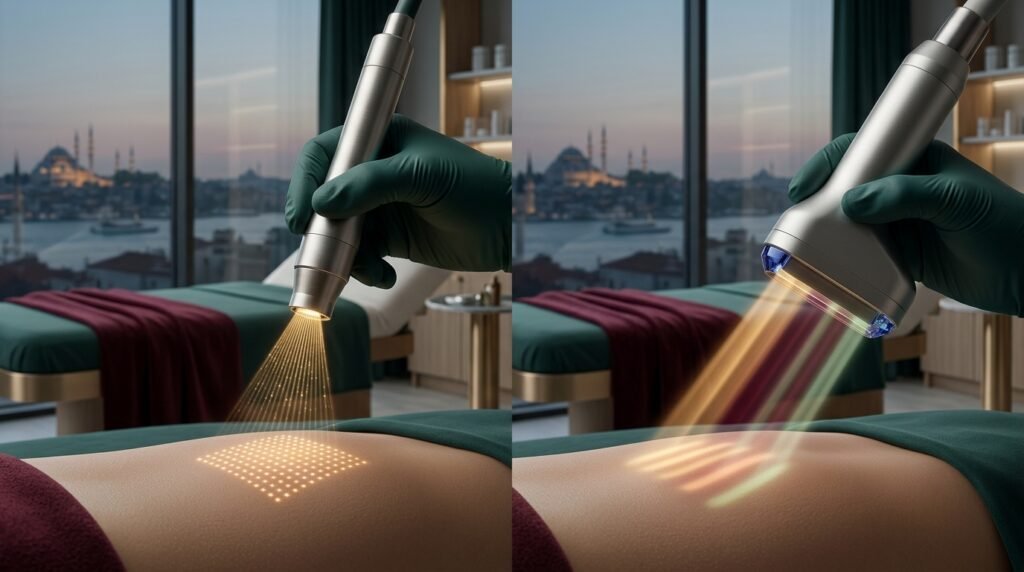
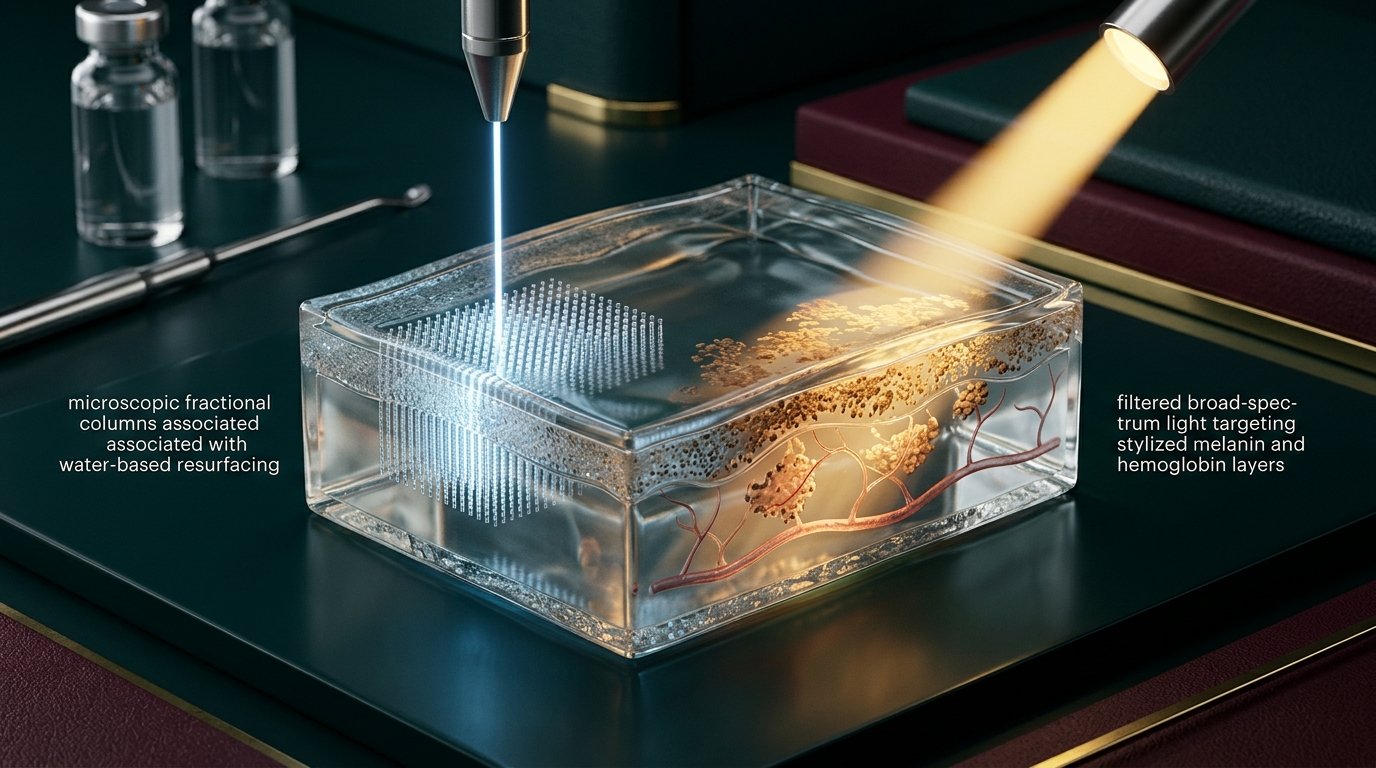
CO2 laser vs BBL is not a comparison between two interchangeable versions of the same treatment. Fractional carbon-dioxide laser resurfacing uses a true laser wavelength that is strongly absorbed by water and creates controlled columns of ablation and thermal injury. BBL is a branded form of intense pulsed light, or IPL: it emits a range of wavelengths that can be filtered so selected chromophores, especially melanin and hemoglobin, absorb light and convert it to heat. One primarily resurfaces tissue; the other primarily treats selected colour-related targets without intentionally removing the epidermis.
The correct choice begins with the problem to solve, not the device name. Acne-scar architecture, etched lines and significant surface texture are different targets from freckles, solar lentigines, diffuse redness and visible vessels. Skin tone, current tanning, inflammatory disease, healing history, medicines, tolerance for wound care, travel plans and realistic risk all change the decision. This guide explains mechanisms, indications, limits, downtime and safety without claiming that either platform suits every person or that a brand alone guarantees a result.
Table of contents
- The short answer
- Start with precise terminology
- How fractional CO2 resurfacing works
- How BBL works
- Chromophores and tissue targets
- Fractional, ablative and non-ablative concepts
- Which concerns fit each category
- Pigment is not one diagnosis
- Redness and vascular concerns
- Acne scars and texture
- Lines, pores and photoaging
- Assessment before choosing
- Skin tone, tanning and competing melanin
- Contraindications and reasons to postpone
- Medicines and health history
- Preparation
- What the appointment may involve
- Comfort and anesthesia
- Downtime compared
- Wound care after CO2
- Aftercare after BBL
- Risks and complications
- Eye protection
- Evidence and limits
- Decision pathways by concern
- Why anatomical area changes the plan
- Season, climate and daily exposure
- A practical complication-response plan
- Photography, endpoints and marketing claims
- Value, packages and informed choice
- Sessions and durability
- Can CO2 and BBL be combined?
- Alternatives
- Planning treatment during an Istanbul trip
- How to evaluate a provider
- Consultation questions
- Common myths
- How the Nexja architecture fits
- CO2 laser vs BBL comparison table
- Frequently asked questions
- Sources and further reading
The short answer
Fractional CO2 laser resurfacing is generally considered when the priority is structural resurfacing: selected acne scars, pronounced texture, etched lines or substantial photodamage in a person who can safely heal an ablative injury. BBL is generally considered when the priority is colour: selected benign brown spots, diffuse redness or small visible vessels in a person whose diagnosis and skin tone make filtered intense pulsed light appropriate. This is a framework, not a prescription.
Choose the target before the technology
“Rejuvenation” is too broad to select a procedure. A face may show a mixture of pigment, vessels, dehydration, laxity, scars and dynamic expression lines. CO2 may improve texture yet be excessive for a few superficial lentigines. BBL may improve selected brown and red targets yet cannot physically remodel a deep tethered scar in the same way as ablative resurfacing. If the main problem is not defined, a technically successful session can still disappoint.
The same person may not need both
Some treatment plans use different technologies at different times, but more devices do not automatically create a better plan. Staging can make it easier to judge response, reduce overlapping inflammation and preserve a clear rescue pathway if pigment or healing problems occur. A conservative option, medical treatment or no procedure may be the best decision when diagnosis is uncertain or travel prevents adequate follow-up.
Start with precise terminology
A laser produces coherent, collimated light at a specific wavelength. A carbon-dioxide laser commonly emits at 10,600 nm, where water is a dominant absorber. IPL produces non-coherent, polychromatic light across a broad spectrum. Filters, pulse structure, cooling and settings shape which wavelengths and tissue targets receive useful energy. The U.S. FDA explicitly states that IPL products do not meet the regulatory definition of a laser.
BBL is branded IPL, not a CO2 alternative by wavelength
Sciton describes BroadBand Light as its proprietary evolution of IPL. The manufacturer offers multiple filters and delivery modes, but this does not turn BBL into a laser. “BBL laser” is common shorthand and technically inaccurate. The distinction matters because wavelength range, optical behavior, eye protection, tissue interaction and expected recovery differ.
CO2 is a laser family, not one universal protocol
“CO2 laser” may refer to fully ablative resurfacing, fractional ablative resurfacing, surgical cutting or other applications. Fractional coverage, energy, density, pulse duration, passes, stacking, anatomical site and aftercare all affect injury. A study using one system and protocol cannot validate every machine or setting sold under the CO2 label.
Brand recognition is not a suitability test
A well-known platform can offer engineering advantages, but the client still needs diagnosis, parameter selection, operator judgment, cooling, eye protection and follow-up. Conversely, a generic category name does not prove poor quality. Ask for the exact device, intended use and rationale rather than using a logo as a proxy for safety.
How fractional CO2 resurfacing works
CO2 laser energy is absorbed strongly by tissue water. In ablative resurfacing, energy vaporizes microscopic volumes of water-containing tissue and leaves a surrounding zone of thermal coagulation. Fractional delivery creates separated columns of injury rather than removing the entire surface uniformly, leaving intervening tissue that can contribute to re-epithelialization. The healing response can reorganize collagen and change surface texture over time.
Ablation and coagulation are both relevant
Ablation removes microscopic tissue; coagulation delivers heat around those channels. The balance influences immediate appearance, healing time and risk. More energy, density or overlapping passes are not automatically better. Excessive thermal injury can delay healing and increase infection, pigment change and scarring risk.
Fractional does not mean superficial
Fractional describes the pattern of coverage, not a fixed depth or mild treatment. A fractional CO2 session can range from conservative to aggressive. Density determines how much of an area is treated, while energy and pulse characteristics influence the individual columns. Anatomical areas outside the central face can heal differently because appendage density and vascular supply vary.
Remodeling takes time
Early swelling can temporarily soften shadows and make texture look smoother. That is not the final collagen result. Re-epithelialization, inflammation and remodeling occur on different timelines. Standardized photographs after the acute recovery period are more informative than an image taken while the skin is swollen or coated with ointment.
How BBL works
BBL delivers filtered pulses of broad-spectrum light. Selected chromophores absorb energy and convert it to heat. For pigment, melanin is a principal target; for vascular concerns, oxyhemoglobin is important. Filter choice, pulse duration, fluence, cooling, spot size, skin tone and lesion depth affect the balance between useful target heating and unwanted epidermal injury.
Filters shape the spectrum
Sciton’s current manufacturer information describes interchangeable wavelength filters for different concerns. A filter does not emit one perfectly monochromatic wavelength; it limits which parts of the broad spectrum reach the skin. Marketing claims about versatility should therefore be separated from independent evidence for a specific indication and population.
Selective photothermolysis is a planning principle
Useful treatment aims to heat the intended chromophore more than surrounding tissue. This requires a suitable wavelength range, pulse duration and energy distribution. Epidermal melanin can compete for light, particularly in darker or recently tanned skin, so an otherwise reasonable pigment setting may create unintended surface heating.
BBL is generally non-ablative
BBL does not intentionally vaporize columns of epidermis in the way fractional ablative CO2 does. That usually means less wound care and shorter visible recovery, but “non-ablative” does not mean risk-free. Burns, blisters, pigment alteration, scarring and ocular injury are possible when selection, settings, cooling or protection are inadequate.
Chromophores and tissue targets
A chromophore is a structure that preferentially absorbs particular wavelengths. Water, melanin and hemoglobin are central to this comparison. The target determines whether the goal is controlled tissue vaporization, pigment heating or vessel heating. A single face can contain all three, but they should not be treated as one undifferentiated sign of ageing.
Water for CO2 resurfacing
Because water is abundant throughout skin, CO2 laser energy can create precise ablative effects independent of a visible brown spot or red vessel. This makes the modality relevant to texture and scar remodeling, but it also means the treatment creates a genuine wound. Healing capacity and aftercare are therefore central parts of candidacy.
Melanin for selected brown targets
BBL can heat melanin within selected benign epidermal pigment. The challenge is that normal epidermis also contains melanin. A tan increases competing pigment and can narrow the safety margin. Melasma and post-inflammatory hyperpigmentation are biologically different from a discrete solar lentigo and may worsen with heat or inflammation.
Hemoglobin for selected vascular targets
Filtered light can be used for diffuse redness or certain superficial vessels after diagnosis. Vessel size, depth and flow affect response. Persistent facial redness can also reflect rosacea, dermatitis, medication, sun exposure or another condition that requires a broader management plan rather than a light session alone.
Fractional, ablative and non-ablative concepts
These words answer different questions. “Fractional” describes spatial delivery in separated microzones. “Ablative” means tissue is vaporized or removed. “Non-ablative” means the epidermis is not intentionally removed, although thermal injury can still occur. Fractional CO2 is ablative and fractional. BBL is normally non-ablative and is not usually described as fractional resurfacing.
Fully ablative resurfacing
Traditional full-field CO2 resurfacing removes a continuous surface over the treated area and can produce substantial change with substantial downtime and risk. Modern practice often favors fractional approaches for selected clients because intervening tissue can support healing. Fully ablative treatment remains a distinct medical decision and should not be conflated with a routine fractional session.
Fractional ablative resurfacing
Fractional CO2 creates microscopic treatment zones separated by untreated tissue. It can still produce oozing, crusting, swelling and a period of barrier disruption. Density, depth, anatomical site and client biology influence recovery. The word “fractional” should never be used to promise a weekend-only recovery.
Non-ablative light treatment
BBL heats selected targets without intentionally creating an open wound. Many clients return to ordinary activities sooner, although temporary redness, swelling and darkening of treated pigment can be visible. Makeup, sun exposure, exercise and heat guidance should follow the actual reaction and provider instructions.
Which concerns fit each category
The strongest practical distinction is structural versus chromatic. Fractional CO2 is considered when controlled ablation and remodeling can address surface irregularity or scar architecture. BBL is considered when selected brown or red chromophores are the main target. Overlap exists in photoaging, but the routes to improvement are different.
Potential CO2 priorities
- Selected atrophic acne scars after scar-type assessment.
- Pronounced rough texture or etched lines in an appropriate candidate.
- Substantial photodamage where ablative resurfacing is justified.
- Selected superficial lesions only after correct medical diagnosis.
Potential BBL priorities
- Selected benign lentigines or freckles.
- Diffuse facial redness or certain superficial vessels.
- Mixed visible signs of photodamage dominated by colour rather than deep texture.
- Maintenance plans where lower downtime is valued and candidacy is appropriate.
Concerns neither device automatically solves
True tissue laxity, deep volume loss, active inflammatory acne, suspicious lesions, uncontrolled melasma, severe dermatitis and dynamic expression lines need separate assessment. A device may complement a plan without correcting the main cause. Our guide to skin tightening treatments in Istanbul explains why firmness, volume and surface quality should not be grouped together.
Pigment is not one diagnosis
Brown colour may represent freckles, solar lentigines, melasma, post-inflammatory hyperpigmentation, seborrhoeic keratoses, a melanocytic naevus or a suspicious lesion. Cosmetic light should not be used to erase diagnostic clues. Any new, changing, asymmetric, bleeding, crusting or otherwise concerning lesion needs medical assessment before treatment.
Benign lentigines and freckles
Well-diagnosed superficial benign pigment may respond to filtered IPL/BBL because melanin absorbs light. Temporary darkening and flaking can occur. Response varies with depth, baseline skin tone, recent sun exposure and settings. Recurrence or new lesions remain possible because treatment does not remove the history of ultraviolet exposure.
Melasma and post-inflammatory pigmentation
Melasma is chronic and influenced by light, heat, hormones and inflammation. Post-inflammatory pigmentation follows injury or inflammation. Both can worsen after aggressive energy. Neither should be treated as a simple collection of sunspots. A plan may prioritize diagnosis, photoprotection, topical or medical management and conservative device use, if any.
CO2 can also alter pigment
Ablative inflammation may improve some aspects of photodamage while also creating post-inflammatory hyperpigmentation or hypopigmentation. Darker skin types have a narrower margin for inflammatory injury, and delayed hypopigmentation can be difficult to correct. Read our focused guide to BBL for pigmentation assessment before assuming all brown marks are suitable targets.
Redness and vascular concerns
BBL can target hemoglobin in selected vascular concerns. CO2 is not the usual first comparison for diffuse redness because its principal resurfacing mechanism targets water and creates inflammation. A person with rosacea may need trigger management, skin-barrier care and medical therapy in addition to or instead of light treatment.
Identify the pattern
Transient flushing, persistent background erythema, telangiectasia and inflammatory papules are not identical. Visible vessels may require different wavelengths or devices according to diameter and depth. A light platform’s filter menu does not replace examination.
Inflammation can mask risk
Active dermatitis, infection or an unstable rosacea flare can increase sensitivity and complicate interpretation of redness after treatment. Stabilizing the condition may be more useful than proceeding because an appointment is booked. Test treatment may be considered when response is uncertain, but a small test does not predict every full-face variable.
Expect gradual change
Vessels may darken, blanch or change over days, and diffuse redness may require more than one session. Complete permanent clearance should not be promised. New vessels can develop with ongoing triggers and sun exposure. Follow-up photographs should use consistent lighting because camera white balance can exaggerate improvement.
Acne scars and texture
Acne scars include ice-pick, boxcar and rolling patterns, often with tethering and mixed depth. Fractional CO2 may improve selected atrophic scars through ablation and remodeling, but one device cannot address every scar component. Subcision, focal techniques, surgical methods, fillers or other energy devices may be discussed depending on anatomy.
BBL does not untether scars
BBL may improve redness or brown post-acne marks in suitable skin, which can make the complexion look more even. It does not mechanically release tethering or create the same ablative columns as CO2. Improvement in colour should not be described as removal of structural scars.
Active acne changes the plan
Ongoing cystic or infected acne may need control before aggressive resurfacing. New scars will undermine a scar-revision plan, and open lesions can increase infection concerns. Medical acne care and realistic sequencing matter. See our professional acne treatment guide for the distinction between active disease, pigment and scars.
Scar improvement is partial
No responsible plan promises scar erasure. Depth, age, location, fibrosis, skin tone and healing biology influence response. Standardized angled lighting can reveal changes that flat frontal light hides. Our comparison of CO2 laser versus microneedling for acne scars explores another common decision.
Lines, pores and photoaging
Photoaging can include mottled pigment, vascular change, roughness, fine lines and loss of elasticity. BBL may address colour-dominant components. Fractional CO2 may address texture and etched lines. Neither replaces lost volume or reliably removes dynamic expression lines caused by muscle movement.
“Pore size” is not a single endpoint
Pores can look larger because of sebum, comedones, surrounding collagen change, dehydration or lighting. Resurfacing may change the appearance of some pores, but pores are normal structures and cannot be permanently deleted. Claims of pore closure should be treated cautiously.
Immediate glow is not remodeling
BBL can create short-term brightness as pigment changes and inflammation settles. CO2 can produce temporary tightening from edema and tissue contraction. Long-term outcomes require follow-up after healing. Comparing immediate photographs from one treatment with late photographs from another is misleading.
Match treatment intensity to priorities
A client who wants modest tone improvement before an event may accept multiple low-downtime sessions but not an open-wound recovery. A client prioritizing scar texture may accept more recovery for a chance of greater structural change. Neither preference is medically superior; it should be informed and realistic.
Assessment before choosing
A professional assessment combines history, examination, photographs and, where useful, non-invasive measurements. It should define the primary concern, skin type, recent sun exposure, inflammatory disease, scarring tendency, healing history, medicines and available recovery time. A scanner score alone cannot choose between CO2 and BBL.
History matters
Discuss cold sores, keloids, delayed healing, pigment reactions, previous lasers, radiation, surgery, autoimmune disease, immunosuppression, diabetes, smoking, pregnancy, medicines and allergies. Previous uncomplicated treatment does not guarantee the next session will be uncomplicated.
Examination matters
Texture should be assessed in moving and angled light; pigment and vessels should be examined closely. Suspicious lesions require medical review. Barrier disruption, dermatitis, sunburn or infection should be identified. The face, neck and chest may not tolerate identical settings.
Goals must be measurable
Define whether success means fewer visible lentigines, less background redness, softer scar edges or smoother fine texture. Use consistent photographs and a time point after acute effects have resolved. Our guide to skin analysis before treatment explains why instruments support but do not replace judgment.
Skin tone, tanning and competing melanin
Baseline skin colour and recent tanning are not cosmetic details; they alter optical absorption and pigment risk. Increased epidermal melanin competes for energy in IPL/BBL and can also respond unpredictably to the inflammation of ablative resurfacing. The 2026 JAAD review on devices in skin of colour emphasizes higher risks of hyperpigmentation, hypopigmentation, blisters and scarring in Fitzpatrick IV–VI.
A tan is not a stable skin type
A recently tanned person may have more epidermal melanin than their usual baseline. Sun, tanning beds and self-tan should be disclosed. Self-tanner does not create melanin but can interfere with visual assessment and may contain ingredients unsuitable around treatment. The safest timing depends on device, exposure and provider assessment.
Darker skin requires tailored strategy
Conservative settings, lower density, careful cooling, test spots and alternative devices may be considered, but no single precaution eliminates risk. Evidence for very dark skin remains less robust in many studies. A provider should be able to explain why the expected benefit justifies the specific pigment risk.
Post-treatment sun exposure matters
Freshly treated skin can develop pigment change after ultraviolet exposure. Istanbul sightseeing, coastal travel or a sunny home destination can conflict with recovery. Photoprotection should be practical, not a generic instruction. If the client cannot avoid intense exposure, postponement may be wiser.
Contraindications and reasons to postpone
Contraindications vary by device, protocol and medical context. Common reasons to postpone include active infection, open wounds, sunburn, significant dermatitis, unstable inflammatory disease, recent tanning and inability to follow aftercare. Pregnancy, photosensitizing medicines, impaired healing and previous procedures require individualized review rather than a universal internet rule.
Active infection and cold sores
Ablative resurfacing can reactivate herpes simplex, and infection can impair healing. A history of cold sores should be disclosed even if the skin looks clear. Prophylaxis decisions belong to the treating medical professional. BBL should also not be delivered over active infection.
Keloids and abnormal scarring
A personal or family history of keloids or hypertrophic scars warrants caution. The risk depends on area, injury and individual biology. A small test area may provide information but cannot guarantee full-face healing. Neck and chest treatment deserve particular attention because healing differs from the central face.
Uncertain lesions
Light can alter a pigmented lesion and complicate later recognition. A changing mole, asymmetric patch, non-healing sore or unexplained vessel should be medically assessed before cosmetic treatment. Referral is not a failed consultation; it is appropriate risk management.
Medicines and health history
Provide a complete list of prescription medicines, over-the-counter products, supplements and recent courses. Photosensitizing agents, anticoagulants, immunosuppressants and drugs affecting healing may change timing or risk. Do not stop prescribed treatment without the prescriber’s advice.
Retinoids require context
Topical retinoids can irritate the barrier, while systemic isotretinoin has historically prompted long waiting periods before resurfacing. Modern evidence has challenged some blanket rules, but treatment choice still depends on dose, timing, procedure intensity and individual healing. The provider should use current evidence rather than a copied fixed interval.
Photosensitizing medicines
Some antibiotics, diuretics, anti-inflammatory drugs and other medicines can increase light sensitivity. The relevance differs by drug and device. Disclose new prescriptions, including short courses started after booking. A careful review is safer than assuming a familiar medicine cannot matter.
Anticoagulants and supplements
Bleeding is not the main mechanism of BBL, but bruising can occur, and ablative procedures may ooze. Aspirin, anticoagulants, fish oil and herbal products should be discussed. Never stop medically necessary therapy for a cosmetic appointment without coordination with the prescriber.
Preparation
Preparation should be specific to the selected procedure and skin. It may include sun avoidance, barrier stabilization, management of inflammatory disease, medication review, antiviral planning and arranging recovery supplies. A universal pre-laser kit is not appropriate for every person.
Before fractional CO2
Plan transport, time away from work, clean linens, gentle cleansing, prescribed aftercare and a reliable contact pathway. Remove unnecessary irritants from the routine as instructed. Do not add aggressive peels, waxing or home devices just before treatment. Confirm who will review healing and what to do if pain, redness or drainage worsens.
Before BBL
Disclose tanning and stop intentional sun exposure. The provider may advise pausing selected active products. Makeup and self-tan should be removed. Confirm the target is correctly diagnosed and that baseline photographs represent ordinary colour rather than temporary flushing.
Do not prepare by self-treating
Using strong hydroquinone, steroids, antibiotics or antivirals without professional direction can cause harm or mask a problem. Preparation should reduce known risk, not create a second uncontrolled experiment. Bring product names and photographs if a previous reaction has occurred.
What the appointment may involve
Both procedures should begin with identity, consent, target confirmation, photographs and eye protection. The room, device checks, skin preparation and emergency readiness should match the technology. Exact settings are individualized and are intentionally not provided here.
Fractional CO2 sequence
The area is cleansed and anesthetized as appropriate. The provider treats in a planned pattern while managing overlap, edges and anatomical variation. Immediate effects can include white microdots, erythema, edema and pinpoint oozing. A dressing or ointment-based aftercare plan may follow.
BBL sequence
The skin is cleansed, protective eyewear is placed and a coupling medium or cooling approach may be used according to the device. Test pulses and endpoint observation can guide treatment. Pulses are delivered with the selected filter and settings. Brown targets may darken; vascular targets may change colour or blanch.
Endpoints require judgment
More redness, more passes or higher energy is not an outcome. Providers watch immediate tissue response while respecting delayed effects. If an unexpected endpoint appears, stopping is safer than completing a predetermined number of passes.
Comfort and anesthesia
Fractional CO2 usually requires more substantial comfort planning because it creates ablative injury. BBL is often described as brief snaps or heat, but sensitivity varies by area and settings. Pain should not be used as proof of effectiveness.
Topical anesthetic is a medicine
Numbing creams have dose, area, timing and absorption considerations. Excessive application or occlusion can be dangerous. The provider should know the product, concentration and total exposure. Do not apply extra anesthetic at home unless specifically directed.
Cooling has a purpose
Cooling can improve comfort and protect the epidermis during light treatment, but it does not make unsuitable settings safe. Contact cooling, chilled gel or air may be used depending on platform. The skin should still be monitored for excessive pain or an unexpected grey-white response.
Comfort planning affects travel
Sedating medicine, nerve blocks or stronger anesthesia may affect transport and observation needs. Visitors should not plan to navigate an unfamiliar city alone immediately afterward. Written instructions should be available in a language the client understands.
Downtime compared
Fractional CO2 generally requires more visible recovery and wound care than BBL. The exact timeline varies with intensity, density, area and biology. Marketing phrases such as “three-day laser” or “no-downtime light” can obscure individual variation.
CO2 recovery phases
Early redness, swelling, warmth, oozing and crusting can be followed by peeling and persistent pinkness. Re-epithelialization does not mean all inflammation has resolved. Makeup, exercise, heat and sun exposure may remain restricted after the surface closes. Prolonged redness can signal deeper injury or another problem.
BBL recovery phases
Redness and mild swelling may settle quickly. Treated brown spots can become darker before flaking or fading. Vascular targets may look temporarily more noticeable. Blisters, severe pain or expanding redness are not routine “purging” and require review.
Social downtime differs from biological downtime
A person may feel comfortable appearing in public before the skin has fully normalized. Conversely, mild medically expected darkening may be socially inconvenient for an event. Ask separately about wound healing, visible appearance and restrictions.
Wound care after CO2
Ablative resurfacing disrupts the barrier, so aftercare is part of the treatment rather than an optional extra. Follow the provider’s specific instructions for cleansing, moisture, dressings and prescribed medicines. Avoid introducing unapproved actives, fragrances or home remedies.
Clean without trauma
Use the recommended water source, cleanser and technique. Scrubbing and picking can delay healing and increase pigment or scar risk. Clean hands and fresh towels matter. Oozing, crusts and ointment can make the skin look alarming, so written examples of expected versus concerning change are useful.
Maintain the recommended moist environment
Many protocols use petrolatum or another occlusive during early healing, while others use specific dressings. The correct product depends on the treatment and allergy history. Too little moisture can allow cracking; inappropriate products can cause contact dermatitis that resembles infection.
Know the red flags
Increasing pain, spreading redness, pus, fever, foul odor, grouped blisters, delayed closure, sharply demarcated white change or new thickening require prompt review. Do not repeatedly treat a presumed allergy with steroids without ruling out infection. Our detailed fractional CO2 recovery and aftercare guide provides a planning framework.
Aftercare after BBL
BBL usually needs less wound care, but the skin has still absorbed thermal energy. Use gentle products, avoid deliberate sun and follow instructions about heat, exercise, swimming and active skincare. Do not scrub darkened pigment away.
Let pigment shed naturally
Selected brown lesions may darken or develop a coffee-ground appearance before fading. Picking can create inflammation and post-inflammatory pigment. If a target becomes very painful, blistered or grey, contact the provider rather than waiting for it to flake.
Control sun exposure
Sun can worsen pigment risk and create new photodamage. Choose broad-spectrum protection appropriate for the skin and reapply as advised. Hats, shade and itinerary changes are often more reliable than sunscreen alone during long outdoor days.
Resume actives cautiously
Retinoids, acids, scrubs and strong antioxidants may sting after treatment. Restart them according to professional guidance and actual skin recovery. A minimal routine makes it easier to identify the cause if irritation develops.
Risks and complications
Both technologies can cause burns, prolonged redness, pigment alteration, infection and scarring, but the pathways and typical recovery differ. CO2 creates an intentional ablative wound; BBL creates selective photothermal injury without planned ablation. Risk depends on client, target, device, settings, technique and aftercare.
Fractional CO2 risks
Expected effects include erythema, swelling, oozing and crusting. Complications can include herpes reactivation, bacterial or fungal infection, acneiform eruptions, contact dermatitis, prolonged erythema, post-inflammatory hyperpigmentation, hypopigmentation and hypertrophic scarring. Delayed healing should be assessed rather than normalized.
BBL risks
Expected effects can include transient pain, redness, edema and temporary darkening of pigment. Complications include blistering, burns, purpura, hyperpigmentation, hypopigmentation, scarring, paradoxical hair effects and ocular injury. Darker or tanned skin can absorb more unwanted energy.
Risk communication should be individualized
A generic consent form is not enough. The provider should explain why this person’s skin tone, target, medicines, history and planned intensity change the probability or impact of harm. Rare events matter more when follow-up will occur in another country.
Eye protection
Laser and IPL eye protection is not a decorative accessory. CO2 laser and BBL involve different spectra, so protection must be appropriate for the actual device and treatment area. Everyone in the controlled treatment space needs suitable protection.
CO2 laser protection
CO2 energy is infrared and can injure ocular tissues. Wavelength-rated eyewear and, for periocular work, properly selected ocular shields may be required. Metal shields, lubrication and placement need professional expertise. Plastic protection can be inappropriate around some laser wavelengths.
IPL/BBL protection
Broad-spectrum light requires protection across the emitted and filtered range. StatPearls notes that IPL can damage pigmented ocular tissues such as the retina. The handpiece should never be fired toward an unprotected eye, and shields should not be moved casually during treatment.
Periocular treatment deserves special caution
Treating near the eyelids increases complexity. Closing the eyes is not protection. Ask what shields are used and who places them. Recent safety audits show that real-world eyewear performance can vary, reinforcing the need for correct, maintained and wavelength-appropriate equipment.
Evidence and limits
Evidence supports fractional ablative resurfacing and IPL for selected indications, but studies vary in devices, settings, populations, outcomes and follow-up. Manufacturer material is useful for understanding platform design, yet it is marketing and should be balanced with independent reviews.
CO2 evidence is indication-specific
Studies report improvement in acne scars, photoaging and texture, but protocols differ widely and comparisons are difficult. High-quality evidence in darker skin types remains limited. Complication rates from old fully ablative techniques should not be applied directly to modern fractional protocols, yet they remain relevant to understanding ablative risk.
IPL evidence is device- and target-specific
IPL has evidence for selected pigmentary and vascular concerns. A 2026 critical review describes expanded applications but also emphasizes heterogeneity. A favorable study of one platform, filter and population cannot prove that every IPL or BBL protocol is equivalent.
Meaningful outcomes matter
Look for blinded evaluation, standardized photographs, validated scales, adequate follow-up and reporting of adverse events. Statistical improvement may be smaller than a client expects. Ask how many participants had your skin type and whether the study compared the device with an alternative.
Decision pathways by concern
A useful consultation does not ask, “Which machine is strongest?” It asks, “What physical feature is creating the concern, what depth is it located at, and what change would be meaningful?” The same word—such as “spots,” “scars” or “rejuvenation”—can point toward very different pathways. A decision tree should remain flexible because mixed concerns are common and because the safest first step may be diagnosis or barrier repair rather than energy.
If the priority is a discrete brown spot
First confirm that the lesion is benign and determine whether pigment is superficial enough for a light-based approach. Review tanning, baseline skin tone, melasma history and previous pigment reactions. BBL may be considered for selected lentigines, but an uncertain lesion belongs in medical assessment. Fractional CO2 may alter surface pigment as part of broader resurfacing, yet it is usually disproportionate when the only goal is a few well-defined spots. A pigment-specific laser or observation may also be reasonable. The choice should reflect diagnosis, not the client’s assumption that every brown mark is sun damage.
If the priority is diffuse redness
Identify whether the pattern is telangiectatic, inflammatory, episodic or medication-related. Filtered IPL/BBL can target hemoglobin in selected cases, whereas ablative CO2 adds inflammation and is not a direct substitute. If papules, burning, scaling or eye symptoms suggest active rosacea or dermatitis, stabilizing the condition may come first. A vascular laser may offer a more specific wavelength for certain vessels. Set an endpoint such as reduction in background erythema under standardized lighting, not a promise of permanent removal of every capillary.
If the priority is scar texture
Classify scars and look for tethering, sharp edges, volume loss and active acne. Fractional CO2 may be one component of scar remodeling, but rolling scars may need release, ice-pick scars may need focal techniques and broad shallow scars may respond differently. BBL can address residual red or brown colour but not the mechanical architecture. A staged plan often makes more sense than combining everything at once. The client should know which step targets which feature and how success will be measured after temporary swelling resolves.
If the priority is general “glow”
Clarify whether dullness comes from dehydration, surface scale, uneven pigment, redness, sleep, lighting or expectations. An ablative procedure may be excessive for a vague, short-term goal. BBL can improve selected colour irregularity but should not be sold as a universal wellness treatment. Gentle skincare, a superficial facial or photoprotection may offer a better risk-benefit ratio before an event. A clear target prevents a low-risk preference from turning into an unnecessarily high-intensity intervention.
Why anatomical area changes the plan
Face, eyelids, neck, chest and hands do not heal identically. Hair follicles and other skin appendages provide reservoirs for re-epithelialization after ablative injury, and their density varies by site. Vascular supply, skin thickness, motion and tendency to scar also differ. Extending a facial protocol onto the neck or chest without adjustment can increase risk. BBL settings likewise need anatomical and pigment-specific planning rather than automatic repetition.
Central face versus jawline and neck
The central face generally has more pilosebaceous units than the neck, which can support faster resurfacing recovery. The neck is mobile, thinner in places and historically associated with greater scarring concern after aggressive ablative treatment. A provider should explain why any planned density or coverage is appropriate for each zone. Blending edges matters, but chasing a perfectly uniform immediate endpoint across unlike anatomy can be unsafe. The same caution applies when treating jawline pigment that extends into recently tanned neck skin.
Periocular skin
Thin eyelid skin can respond to resurfacing, yet treatment near the eye requires precise protection and knowledge of ocular anatomy. Ordinary external goggles may block access to the very area being treated, while internal shields require correct selection, lubrication, placement and removal. BBL near the orbital rim also demands secure broad-spectrum protection. A client should never be asked to rely on closed eyelids. Periocular swelling may be dramatic even when expected, so travel and social recovery should be discussed in advance.
Chest and hands
The décolletage and dorsal hands often show pigment and photodamage, making light treatment attractive, but they can have different healing and pigment responses from the face. Ablative treatment outside the face may require more conservative planning. Sun exposure is also harder to avoid on hands. A full treatment map should specify each area rather than using “face and body” as a single protocol. If several zones are treated, the burden of aftercare and total inflammatory load should remain manageable.
Edges and cosmetic units
Resurfacing only a small patch can create temporary or persistent contrast in colour and texture. Providers may feather settings or treat an entire cosmetic unit, but broader coverage also increases recovery. BBL spot treatment can similarly leave a mosaic appearance if only the darkest visible lesions are addressed. The plan should balance blending with total exposure, and the client should understand that untreated surrounding skin will continue to age and tan.
Season, climate and daily exposure
There is no universal “laser season,” but ultraviolet exposure, heat, humidity, work and travel affect practicality. Autumn or winter may make sun avoidance easier for some people, yet snow, altitude and bright winter light still matter. Istanbul can be sunny in every season. The correct date is one when the client can protect the skin, follow aftercare and access review.
Sun exposure before treatment
Intentional tanning, beach holidays, outdoor work and recent burns should be disclosed. A tan changes epidermal melanin and may not be fully captured by a questionnaire asking only for natural skin type. Photographs from several weeks earlier can help show the baseline, but in-person examination remains necessary. If the planned trip includes Cappadocia, the coast or long walking tours, the schedule should account for cumulative exposure. Lowering energy does not automatically make treatment worthwhile or safe on recently tanned skin.
Heat, sweat and humidity
After resurfacing, heavy sweating and heat can sting, increase swelling and complicate wound care. After BBL, heat may intensify redness or discomfort. Work in kitchens, gyms, saunas or outdoor environments should be discussed. Humid weather does not replace correct moisturization, and dry indoor air does not justify over-applying unapproved products. The provider’s restrictions should be realistic for the client’s occupation and accommodation.
Cold and wind
Cold air and wind can aggravate dryness and sensitivity. Scarves may rub newly treated skin, while indoor heating can reduce humidity. Choose soft, clean fabrics and avoid occluding the face with an unwashed garment. Sunscreen is still needed when ultraviolet exposure is possible. A winter appointment should not be marketed as risk-free simply because temperatures are lower.
Events and camera-facing work
Allow a buffer beyond the advertised downtime. CO2 redness can persist after the surface closes, and BBL pigment can darken temporarily. High-definition lighting may reveal flaking that is not obvious in ordinary life. Do not schedule an aggressive first treatment immediately before a wedding, broadcast, passport photograph or business presentation. A consultation or conservative skin-care plan may be a better use of the visit.
A practical complication-response plan
Good safety is not the claim that complications never occur; it is the ability to recognize, document and manage them early. Before treatment, the client should know what is expected, what is unusual, who answers outside normal hours and where medical assessment occurs. Visitors need a plan that works after they leave Türkiye. Written product, device and treatment records support continuity without encouraging self-treatment.
Expected evolution versus deterioration
Expected CO2 recovery should trend from acute warmth, swelling and oozing toward closure and decreasing discomfort. Expected BBL recovery may include transient redness and darkened pigment. Increasing pain, rapidly expanding redness, pus, fever, foul odor, grouped blisters, grey-white tissue, marked asymmetry or new visual symptoms are not signs that the procedure is “working harder.” A timeline and photographs help the provider judge change. When in doubt, prompt review is safer than waiting for the next routine appointment.
Possible infection
Ablative wounds can develop bacterial, viral or fungal infection. Herpes reactivation may occur even in someone who does not remember a recent outbreak. Do not apply leftover antibiotics, steroids or essential oils. Culture, viral testing or targeted therapy may be needed. Contact dermatitis can mimic infection, and steroids can worsen an unrecognized infection, so diagnosis matters. Persistent acne-like bumps after resurfacing should not automatically be squeezed or treated as ordinary acne.
Possible burn after BBL
Severe or escalating pain, blistering, sharply demarcated darkening or pale/grey change requires prompt assessment. Cool compresses may be recommended, but ice directly on skin can add injury. Do not peel blisters or cover them with fragranced cosmetics. Document the onset and any products applied. Early professional evaluation can help distinguish expected pigment darkening from epidermal injury and guide wound care intended to reduce infection and pigment change.
Persistent pigment change
Post-inflammatory hyperpigmentation can develop after either procedure, especially in darker skin or after sun exposure. Hypopigmentation may appear later and can be difficult to treat. Aggressive bleaching, repeated energy or exfoliation without diagnosis can worsen the problem. The response may include photoprotection, time, topical or medical treatment and avoidance of further injury. Before another session, the original indication and parameters should be reassessed rather than repeated automatically.
Scarring and prolonged redness
Delayed closure, firm thickening, increasing edge elevation or persistent intense redness may signal excessive injury, infection or evolving scar. Early review matters because management is time-sensitive. Photographs should be compared with baseline and previous follow-ups. A referral to an experienced dermatologist or surgeon is appropriate when the complication exceeds the treating setting’s scope. Continuing a prepaid package while healing is abnormal is unsafe.
Photography, endpoints and marketing claims
Before-and-after images can educate, but they can also mislead. Exposure, angle, focal length, white balance, expression, makeup and surface moisture change apparent redness, pigment and texture. An ethical comparison uses consistent conditions and states the interval. Immediate photographs after CO2 are not outcome photographs, while BBL images taken after pigment darkens can exaggerate either harm or later improvement.
Standardize the setup
Use the same camera, distance, lens, background and lighting. Capture frontal, oblique and side views with neutral expression. Cross-polarized or ultraviolet imaging can add information but should not be presented as a medical diagnosis. Texture assessment benefits from controlled angled light; vascular assessment needs stable colour calibration. Record whether makeup, moisturizer or sunscreen was present. If the clinic changes rooms or cameras, note that limitation rather than treating every visual difference as biological change.
Choose the right follow-up time
CO2 swelling can temporarily soften lines and scars, while later remodeling may continue for months. BBL redness may settle quickly, and treated pigment may take days to shed. A meaningful endpoint should be timed after transient effects. Multiple follow-ups can show early safety, intermediate response and durability. Clients should know which photograph is being used for clinical comparison and whether it may be shared publicly.
Respect consent and privacy
Consent to treatment is not consent to marketing. Image use should be optional, specific and revocable where applicable. Cropping the eyes does not always anonymize a face. International clients may have particular privacy concerns. A clinic should not pressure someone to trade photographs for a discount. Internal clinical documentation can remain necessary even when public use is refused.
Read claims critically
“FDA cleared” does not mean every use, setting or combination was evaluated. “Clinically proven” may refer to a small manufacturer-sponsored study. “No downtime” may mean no formal work restriction, not absence of visible reaction. “One treatment” may describe a marketing protocol rather than a guarantee. Ask for the exact indication, comparator and follow-up. A responsible explanation distinguishes manufacturer specifications, independent evidence and the provider’s experience.
Value, packages and informed choice
Price cannot determine suitability. A more expensive branded platform may offer engineering, support or workflow advantages, while a less expensive treatment may still be appropriate. What matters is the complete clinical value: assessment, correct diagnosis, device maintenance, safety, treatment time, consumables, aftercare and complication access. This guide deliberately avoids prices because availability and packages change.
Do not compare only the session label
Two “fractional CO2” sessions may differ in area, density, intensity, anesthesia and follow-up. Two “BBL” sessions may use different filters, targets and coverage. Ask what is included, what is optional and whether the price assumes a package. A cheap session that omits assessment or follow-up can become expensive if a complication is managed elsewhere. An expensive session is not automatically superior if the indication is unclear.
Packages should remain conditional
A prepaid series should not force the provider to repeat treatment when response, tanning, pregnancy, medicine or skin disease changes. The plan needs review before each session. Clients should understand expiry, cancellation and refund rules before purchase. A package number is a commercial structure, not a biological prediction. First-session response may justify modifying, spacing or stopping treatment.
Opportunity cost matters
Recovery days, travel changes, products, medicines and time away from work are part of the cost. If the likely improvement is modest, a lower-intensity alternative may provide better value. Conversely, repeated low-impact treatments can cost more than one appropriately selected procedure. Shared decision-making compares expected benefit, uncertainty, burden and alternatives, including doing nothing.
Transparent uncertainty builds trust
No provider can promise exactly how much a scar will soften or how long redness will stay away. A useful estimate includes a range and the factors that move it. The client should leave knowing what the treatment is designed to change, what it cannot change and what would make the plan stop. That clarity is more valuable than a guaranteed percentage.
Sessions and durability
Fractional CO2 may be performed as one more intensive session or a series of lower-intensity sessions. BBL is commonly planned as a series and maintenance, but no universal number applies. Treatment count depends on target, response, settings, risk and endpoint.
One session is not a guarantee
A single CO2 session can produce meaningful change for selected concerns, yet scars and texture often remain. One BBL session may improve some spots but not diffuse or deeper concerns. Package size should not be chosen before diagnosis and first-response assessment.
Results can change over time
Collagen remodeling evolves after resurfacing. Pigment and vessels may recur with sun, hormones, inflammation or ageing. Maintenance does not mean the first treatment failed; it reflects ongoing biology. However, repeated procedures should still have a clear indication.
Photoprotection protects the investment
Neither device prevents future ultraviolet damage. Daily photoprotection, appropriate home care and management of underlying conditions influence durability. A clinic cannot guarantee permanence when the target is biologically active.
Can CO2 and BBL be combined?
Some clinicians stage or combine modalities to address texture and colour, but the sequence should be justified. Stacking increases inflammation and variables. There is no rule that every “full rejuvenation” plan must include both.
Staging improves attribution
Separating sessions allows the first response to settle before adding another intervention. If pigment worsens or healing is delayed, the cause and next step are clearer. The interval depends on intensity, area and recovery, not a universal calendar.
Same-day treatment needs a strong rationale
Combining thermal and ablative injury can increase burden. The provider should explain evidence, sequence, endpoints and rescue plan. Convenience should not override safety. A package discount is not a clinical indication.
Sometimes one technology is enough
If colour is the principal concern, BBL or another pigment/vascular approach may be sufficient. If scar texture dominates, a resurfacing or scar-specific plan may be more logical. If both are mild, conservative skincare and sun protection may provide better risk-benefit value.
Alternatives
Alternatives depend on the target. Options can include non-ablative fractional lasers, erbium resurfacing, vascular lasers, pigment-specific lasers, microneedling, radiofrequency microneedling, chemical peels, medical skincare, injectables, surgery or observation. Each has its own evidence, downtime and risk.
Non-ablative fractional lasers
These create thermal microzones without intentionally vaporizing the surface. They may offer less downtime but often require a series and can still cause pigment change. Wavelength and target matter. “Fraxel” is sometimes used generically but is a brand, not a complete treatment description.
Erbium ablative resurfacing
Er:YAG wavelengths are absorbed strongly by water and can ablate with a different thermal profile from CO2. The practical result depends on device and settings. It should not be described as automatically safer for every skin type or concern.
Microneedling and peels
Microneedling can address selected texture with less thermal pigment risk, while peels target controlled chemical injury at chosen depths. Both require suitability assessment. Read our skin rejuvenation decision guide before choosing by trend.
Planning treatment during an Istanbul trip
Travel adds sun exposure, flights, unfamiliar products and distance from the treating provider. A visitor should plan the treatment around recovery and follow-up, not force recovery into a flight schedule. Fractional CO2 demands a larger buffer than BBL in most cases.
Before arrival
Send accurate history and photographs, but expect in-person confirmation. Disclose tanning, beach holidays and recent procedures. Do not prepay for a non-refundable aggressive treatment before candidacy is assessed. Arrival-day dehydration or flushing can distort examination.
After fractional CO2
Plan for visible wound care, limited sun, clean supplies and possible review. Long flights can be uncomfortable, and masks or touching can irritate treated skin. A complication beginning after departure is harder to manage. Build time for at least one in-person check according to the provider’s protocol.
After BBL
Recovery is often easier, but outdoor sightseeing can conflict with sun avoidance, and darkened spots may be visible in photographs. Know how to contact the clinic and when to seek local care. Do not schedule treatment immediately before a high-sun destination.
Carry documentation
Request the exact device and treatment date, areas, aftercare, medicines and contact information. If a reaction occurs at home, a local clinician needs more than “I had a laser in Istanbul.” Records support continuity without implying that settings must be shared publicly.

How to evaluate a provider
Choose a provider who can diagnose the target, explain alternatives, select parameters for the individual, maintain laser/IPL safety and manage complications. Specific professional qualifications and legal scope depend on jurisdiction and procedure. Do not infer them from a social-media title.
Green flags
- The consultation separates pigment, vessels, texture, scars and laxity.
- The exact technology and why it fits are explained.
- Skin tone, tanning, medicines and healing history are documented.
- Eye protection is device-appropriate and taken seriously.
- Expected recovery and warning signs are provided in writing.
- The provider can postpone or refer without pressure.
Red flags
- Calling BBL a laser while refusing to explain the difference.
- Guaranteeing scar erasure, pore closure or permanent pigment removal.
- Treating a changing lesion without medical assessment.
- Ignoring tan, skin tone or photosensitizing medicine.
- Using generic sunglasses or no eye protection.
- No plan for infection, burn, pigment change or delayed healing.
Ask about complication ownership
Who reviews the skin if pain worsens at night? Who diagnoses infection or scarring? How are records shared after travel? A reassuring answer acknowledges uncertainty and has a pathway. “We never have complications” is not a safety system.
Consultation questions
About the diagnosis
- What is my primary target: pigment, vessels, texture, scars or laxity?
- Has every pigmented lesion been assessed as benign?
- Could melasma, rosacea or dermatitis change the plan?
- How does my baseline skin tone and recent sun exposure affect risk?
About the technology
- Is this fractional ablative CO2, full-field CO2 or filtered IPL/BBL?
- What tissue or chromophore is being targeted?
- Why is this device preferred over a simpler alternative?
- What evidence supports it for my concern and skin type?
About recovery and safety
- What wound care, downtime and sun restrictions should I expect?
- What eye protection will be used?
- What symptoms require urgent review?
- Who provides follow-up after I leave Istanbul?
About outcomes
- What change is realistic after one session?
- How will photographs be standardized?
- When will the result be assessed after swelling resolves?
- What might not improve?
Common myths
Myth: BBL is a laser
Reality: BBL is a branded form of IPL that produces filtered broad-spectrum, non-coherent light. FDA materials distinguish IPL products from lasers.
Myth: CO2 is simply a stronger BBL
Reality: The mechanisms and targets differ. CO2 energy is absorbed by water and creates ablation; BBL primarily heats selected chromophores such as melanin and hemoglobin.
Myth: Fractional means no downtime
Reality: Fractional CO2 can create significant wound care and visible recovery. Fractional describes spatial coverage, not mildness.
Myth: BBL has no downtime or risk
Reality: Pigment darkening, redness and swelling can occur; burns, blisters, pigment change, scarring and eye injury are possible.
Myth: Darker skin cannot receive any device treatment
Reality: Some treatments can be performed with careful selection and tailored parameters, but competing epidermal melanin and inflammatory pigment risk require expertise. Evidence gaps should be acknowledged.
Myth: Higher energy produces better results
Reality: Excess energy can exceed tissue tolerance and cause complications. The goal is a controlled therapeutic endpoint, not maximal redness or pain.
Myth: A famous device guarantees the operator
Reality: Engineering matters, but diagnosis, technique, parameter selection, protection and follow-up remain decisive.
Myth: One treatment removes all photodamage
Reality: Photoaging contains pigment, vessels, texture and structural change. Multiple strategies and continued photoprotection may be needed.
How the Nexja architecture fits
Nexja Select means curating technologies, products and protocols according to the person and target rather than choosing the most famous device. It does not mean that every platform is stocked or that one named procedure is automatically included. Selection must remain traceable and appropriate.
Nexja Butterflies refers to the selected skilled transformation team and personnel, not clients. In an energy-based plan, team quality includes assessment, transparent explanation, device-specific safety, consistent photography, aftercare and referral when a concern is outside cosmetic scope.
Nexja Experience is the complete journey from inquiry and skin assessment through personalized planning, treatment, recovery and follow-up. “You Choose Change. We Create the Transformation.” is meaningful only when realistic limits, alternatives and safe postponement are part of the experience.
CO2 laser vs BBL comparison table
| Feature | Fractional CO2 laser | BBL / filtered IPL |
|---|---|---|
| Technology | True laser, commonly 10,600 nm | Broad-spectrum non-coherent intense pulsed light |
| Primary absorber | Water | Filtered targets such as melanin and hemoglobin |
| Main tissue effect | Microscopic ablation plus thermal coagulation | Selective photothermal heating without planned ablation |
| Common priorities | Texture, selected acne scars, etched lines, resurfacing | Selected benign brown spots, redness and superficial vessels |
| Barrier | Intentionally disrupted | Usually remains intact |
| Typical recovery | More wound care, swelling, oozing, crusting and prolonged redness | Usually shorter; redness, swelling and darkening of pigment possible |
| Pigment risk | Inflammatory hyperpigmentation or hypopigmentation | Epidermal melanin competition, burns and pigment alteration |
| Tanning | Raises pigment and healing concerns | Raises epidermal absorption and burn/pigment risk |
| Eye protection | Protection rated for CO2 wavelength; special periocular precautions | Protection across the emitted filtered spectrum |
| Best choice decided by | Diagnosis, skin tone, target depth, history, downtime, risk and professional assessment—not brand alone | |
Frequently asked questions
Is BBL a laser treatment?
No. BBL is a branded form of intense pulsed light. It emits a broad range of non-coherent wavelengths that are filtered for selected targets. A laser emits coherent light at a defined wavelength. The casual phrase “BBL laser” should not obscure that technical difference.
Is fractional CO2 ablative?
Yes. Fractional CO2 creates microscopic columns of ablation and surrounding thermal effect while leaving intervening tissue untreated. Fractional describes the pattern, not the absence of ablation.
Which is better for acne scars?
Fractional CO2 may be considered for selected atrophic scars because it remodels tissue. BBL can improve red or brown post-acne marks but does not release tethered scars. Scar type, skin tone and active acne determine the plan.
Which is better for sunspots?
BBL may suit correctly diagnosed benign superficial pigment in an appropriate untanned candidate. CO2 can improve broader photodamage but carries greater recovery. Suspicious or changing spots need medical assessment first.
Which is better for redness?
Filtered IPL/BBL may target hemoglobin in selected redness and vessels. CO2 resurfacing is not generally the first technology chosen solely for diffuse redness. Rosacea or dermatitis may require medical management.
Can CO2 laser remove melasma?
Melasma is chronic and can worsen after heat or inflammation. Ablative resurfacing is not a guaranteed cure. Diagnosis, skin type, hormonal factors, photoprotection and medical management should guide any device discussion.
Can BBL treat deep acne scars?
BBL does not create the same ablative remodeling or release scar tethering. It may improve colour around scars, which can improve overall appearance, but deep structural scars usually need scar-specific assessment.
Does fractional CO2 tighten skin?
Thermal injury and collagen remodeling may create some improvement in fine laxity, but it does not replace surgery for substantial tissue descent or restore lost volume. Temporary swelling can exaggerate early tightness.
Does BBL tighten skin?
Some branded modes make skin-quality or firmness claims, but results depend on platform, protocol and individual biology. BBL should not be presented as a substitute for surgery or as a guaranteed lifting treatment.
Which has more downtime?
Fractional CO2 generally has more downtime because it intentionally disrupts the barrier. BBL often has shorter recovery, but visible darkening, redness and swelling can still affect events and photographs.
How long does CO2 healing take?
It varies with density, depth, area and individual healing. Surface closure is only one milestone; redness and sensitivity can last longer. The provider should give a range and arrange review rather than promise an exact day.
Can I fly after fractional CO2?
Flying itself is not the only issue. Wound care, dryness, masks, touching, sun exposure and distance from the provider matter. Plan a recovery buffer and follow the treating professional’s advice.
Can I fly after BBL?
Many clients travel sooner after BBL, but swelling, heat sensitivity and sun exposure can still be inconvenient. Darkened pigment may be visible. Know how to obtain follow-up after departure.
Can CO2 and BBL be done on the same day?
Some clinicians use combined protocols, but same-day treatment is not automatically better. It adds variables and inflammatory burden. The provider should explain evidence, sequence and why staging is not preferable.
Is a test spot enough to guarantee safety?
No. A test spot can reveal some immediate reactions but cannot reproduce full-face density, overlap, anatomy, aftercare or delayed pigment. It supports judgment rather than replacing it.
Can darker skin have CO2 laser?
Selected darker skin types may be treated by experienced professionals using tailored strategies, but risk of post-inflammatory pigment and scarring is higher. Evidence is less complete for the darkest skin types. Alternatives may offer a better risk-benefit balance.
Can darker skin have BBL?
Competing epidermal melanin can increase burn and pigment risk. Suitability depends on exact skin tone, tan, filter, target and platform. A brand name does not remove this limitation.
What if I am tanned?
Recent tanning can narrow the safety margin, especially for pigment-targeting light. Disclose sun and tanning-bed exposure. Postponement may be safer than lowering settings and hoping for benefit.
Do I need eye protection for both?
Yes. Protection must match the actual laser wavelength or IPL spectrum and treatment area. Closing the eyes or wearing ordinary sunglasses is not adequate.
Can either treatment remove pores permanently?
No. Pores are normal structures. Treatments may improve their appearance by changing surrounding texture or sebum-related factors, but permanent pore removal is not realistic.
Can either treatment erase scars?
No. Fractional CO2 may soften selected scars; BBL may improve surrounding colour. Complete erasure should not be promised. Mixed scars often need multiple methods.
Why did my brown spots get darker after BBL?
Selected pigment can darken temporarily before flaking or fading. Do not pick it. Severe pain, blistering, grey colour or spreading redness is not routine and needs review.
Why is my skin still red after CO2?
Redness can persist after resurfacing, but the expected duration depends on intensity and healing. Worsening pain, discharge, fever, blisters, delayed closure or thickening requires prompt assessment for infection or deeper injury.
How many sessions will I need?
There is no universal number. CO2 intensity and target may favor one session or a series; BBL often uses a series. First response and adverse effects should inform further treatment rather than committing blindly to a package.
How do I choose between them?
Define the primary target, confirm diagnosis, assess skin tone and tanning, review healing and medicines, compare downtime and discuss alternatives. Choose the plan with the clearest rationale and acceptable risk, not the most familiar brand.
What should I ask before paying?
Ask for the exact technology, diagnosis, target chromophore or tissue effect, expected recovery, eye protection, realistic outcome, complication pathway and follow-up plan. Confirm that final candidacy is decided after assessment.
Sources and further reading
- Sciton: BBL HEROic manufacturer information
- Sciton: why BBL is not technically a laser
- FDA: laser definition and IPL radiation-product requirements
- FDA: aesthetic cosmetic devices, benefits and risks
- NCBI StatPearls: Intense Pulsed Light therapy
- NCBI StatPearls: Carbon Dioxide Laser Resurfacing
- American Society for Dermatologic Surgery: Laser Resurfacing
- Fractional CO2 Laser Resurfacing Complications
- JAAD 2026: laser and energy-based devices in skin of color
- 2026 critical review of clinical IPL applications
- American Academy of Dermatology: conditions lasers can treat
This educational guide does not diagnose a lesion, determine candidacy or replace individual medical advice. Device regulation, professional scope and product availability vary by jurisdiction and can change.


